
Oil Sample Analysis
Oil analyses are similar to human blood analyses. They show what values and elements are acceptable and which values indicate a problem.
Based on oil analysis, benchmarks can be set, and machines with critical levels can be identified quickly.
Understanding an oil analysis report
The purpose of oil sampling is to achieve the highest level of machine performance and reliability by checking the condition and, very importantly, the contamination level of the oil.
Oil analyses are the only method to get reliable feedback about your oil & machine condition.
We at Triple R Europe are cooperating with various oil analysis laboratories, like WearCheck or Filtrex Services, which are all independent laboratories.
Apart from the primary oil data, like the viscosity, oil acidity, water content, and spectral analysis… we always perform a PARTICLE COUNT. We deliberately emphasize this.
That’s important because the chemical properties of a fluid might be okay, but solids, water and sludge might contaminate your oil. And in that case, your machine is definitely in trouble. So, better check and know about the various other pollutants, too.
We have 33 years of experience with oil analysis reports. If you would like to get more detailed explanations or in-depth assistance about the condition of your oil, contact your local TRIPLE R distributor.
Oil analysis: how to read the data?
As a minimum an oil analysis should include:
-
Particle count (ISO 4406 or NAS 1638)
-
Water content in ppm
-
Viscosity
-
Acidity level (TAN)
-
Spectral Analysis (wear metals and additive package).
-
0,8 micron Millipore filter membrane for Sludge detection, or a MPC test
Maximum values:
Particle count
A particle count is essential and should be an integral part of every oil analysis!
As a guideline, the degree of contamination should not be higher than what is required for the most sensitive part of the hydraulic system. For example, if the system uses servo-vales, a NAS class 6 or better is most important.
In general, hydraulic systems should not exceed a NAS 7 or ISO 18/16/14 class.
Water
Water content is expressed in PPM (parts per million). 1 PPM = 0,0001%. As a rule of thumb water concentration should not exceed 300 PPM (0,03%).
Viscosity
The viscosity is expressed in cSt. For hydraulic oil typical oil viscosity are 32 cSt, 46 cSt and 68 cSt mg/KOH gr. For lube oil typical oil viscosity are 220 cSt and 320 cSt. The oil viscosity may vary within a range of 25% up or down the initial viscosity. Meaning that a 46 cSt oil will still be within an acceptable range if the measured viscosity is between 33 and 59 cSt.
Acidity Level
Total Acid Number (TAN): the acidity level or TAN is expressed in mg/KOH gr. Every oil has a maximum TAN value. Ask your oil supplier about your oil maximum TAN level. Typically for hydraulic the maximum level is 1,0 mg/KOH gr. New fresh oil will start around 0,2 mg/KOH gr.
Spectral analysis
Do not make that widespread mistake of using spectral analysis to define your oil contamination. It’s senseless because a spectral analysis measures elements below 3 microns, some solids, but mainly chemical compositions!
A spectral analysis measures the so-called “wear metals” and the additive package. Useful, especially regarding the concentrations of the additives. However, note that a spectral analysis is not a substitute for a Particle Count!
It’s essential to have the possibility to compare multiple spectral analyses and to check the trend. Are the wear metals increasing significantly? Are the additives vanishing?
Particle counting standards
ISO 4406 Standard
The ISO 4406/2000 classification of particle contents was introduced to facilitate comparisons in particle counting.
You can download the iso 4406 pdf file here.
A sudden breakdown in an oil system is often caused by medium sized particles (>14 micron) in the oil while slower, progressive faults, e.g. wear and tear, are caused by the smaller particles (4-6 micron).
This is one of the explanations why the particle reference sizes were set to 4 micron, 6 micron and 14 micron in ISO 4406/2000.
A typical sample contains in every 100 ml of oil:
450,000 particles >4 micron120,000 particles >6 micron14,000 particles >14 micronIntroduced in the ISO classification table (on the right), this oil sample has a contamination class of 19/17/14.
NAS 1638 Standard
NAS 1628 is a American standard that references the contamination load based on a breakdown of the different particle sizes for specific particle sizes: 5 to 15 micron, 15 to 25 micron, 25 to 50 micron, 50 to 100 micron, >100 micron.
NAS 1628 is a American standard that references the contamination load based on a breakdown of the different particle sizes for specific particle sizes: 5 to 15 micron, 15 to 25 micron, 25 to 50 micron, 50 to 100 micron, >100 micron.
Download the NAS 1638 pdf file.
The difference is that the NAS gives a detailed breakdown of the different particle sizes lager than 5 micron.
Evaluation of the particle count
The obtained ISO and NAS code is an indication of the cleanliness of the oil in the system and can be verified in the contamination charts shown above.
Contamination guide for hydraulic and lube oil systems
-
ISO 14/12/10 - NAS 4: Very clean oil, best for all oil systems.
-
ISO 16/14/11 - NAS 5: Clean oil, an absolute necessity for servo & high pressure hydraulics.
-
ISO 17/15/12 - NAS 6: Light contaminated oil, standard hydraulic and lube oil systems.
-
ISO 19/17/14 - NAS 8: New oil, for medium to low pressure systems.
-
ISO 22/20/17 - NAS 12: Very contaminated oil, not suitable for oil systems
View the cleanliness recommandations
For every oil-filled system, a cleanliness target should be specified. This is the basic requirement to insure reliability at the lowest possible cost. A millipore membrane can show oil degradation if a 0,8 micron cellulose membrane is utilized.
Frequency of analysis
In the implementation phase of a condition monitoring system, analyses must be made frequently – at least every six months – in order to establish a knowledge data base. Every oil system should have a log where analysis results are registered. The logbook must also contain information about oil type, oil changes, break-downs, targeted ISO class code and oil analysis results.
To take an oil sample, the following is required:
-
a 200 ml particle-free glass bottle
-
a five-litre open oil container
-
a cloth
Where to take an oil sample?
Derive the oil from a preferably upwards pointing pipe with continuous flow to produce a representative sample. Sampling points fitted on the lower perimeter of a pipe tend to allow depositing of particles in the sampling valve. A sample taken between the pump and the filter housing of an off-line filter is normally the worst contaminated part of the oil system, and therefore the most representative for the total systems contamination load. If no off-line filter system is installed, a vacuum type sampling pump is a valid option. In such case the sample should be drawn 10 cm off the lowest part of the tank.
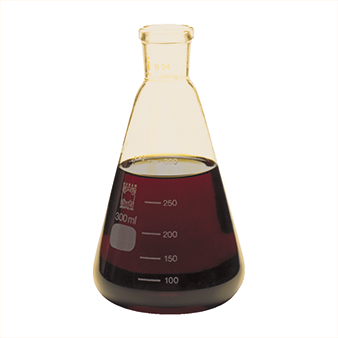
Please read the following instructions carefully before taking the oil sample
1) Place the oil container beneath the sampling valve.
2) Open and close the valve five times and leave it open.
3) Flush the pipe by draining one litre into the container.
4) Open the sample bottle but avoid contamination to ingress.
5) Place the bottle under the oil flow without touching the sampling valve.
6) Fill the bottle approximately 80% full.
7) Place the cap on the bottle immediately after taking the sample.
8) Shake the bottle, empty the oil in the container and repeat filling.
9) Close the sampling valve.
10) All samples must be clearly marked with reference number, machine reference number, machine make and model, place of sampling, date and oil type/make.
Samples should only be collected with the machine operating at normal working temperature.
When sampling for particle counting the method is very important. Remember that you can never make a sample any better (cleaner) than the oil in the system, but it is easy to make it worse.
Contact Us for Comprehensive Solutions
Experience our top-notch filtration and oil cleaning solutions designed to meet your specific needs. Our dedicated team is ready to assist you with any inquiries, technical support, or scheduling consultations.
Contact us